
Auf der Jagd nach dem aktiven Zentrum - Video
By clicking on the button below, data is loaded from the following external servers:

More than 95% of all chemical products have seen a catalyst during their production, hence, catalysis plays a tremendeous role, presently being a 3 trillion $ / year market of chemical industry. Heterogeneous catalysis is a substantial part of it, and the great importance of emission control for environmental and human health is obvious.
Despite this importance, still very little is understood about the mechanisms on a truly atomic scale which is necessary for better control of function on all length scales up to the macroscopic. Consequently, catalyst design has been more empirical than knowledge-driven up to now. More than 60% of the noble metals produced worldwide are used in catalysis. As noble metals are finite resources, there is an urgent need to reduce their content in catalysts to the effective minimum, the so-called active site. Structural changes under process conditions and their pronounced heterogeneity often pose a great challenge for knowledge-based design. New perspectives are evolving, e.g. in the preparation of defined metal clusters/particles, their characterization, and theoretical modeling, allowing to track and fundamentally understand the active sites in catalytic systems. This is the starting point of this interdisciplinary Collaborative Research Centre, where we aim at a holistic understanding by linking the different length scales and catalyst complexity levels. Our scale-bridging approach connects three areas: (A) size-selected clusters and defined nanoparticles, (B) porous catalysts with noble metal particles of defined size on support oxides with oriented surfaces and (C) hierarchically structured catalysts at the reactor level.
 |
 |
 |
The goal of TrackAct is to identify and track the nature of the active site, to design and manipulate them from bottom-up across the various length scales, and - on a long-term vision - predict and actively control them during operation.
TrackAct officially started on January 1st 2021 (press release from DFG and KIT). Since January 2025, it is in the second funding phase (press release from DFG https://www.dfg.de/en/service/press/press-releases/2024/press-release-no-47 and KIT).
Auf der Jagd nach dem aktiven Zentrum - Video
By clicking on the button below, data is loaded from the following external servers:
Auf der Jagd nach dem aktiven Zentrum - Video
By clicking on the button below, data is loaded from the following external servers:
Katalyseforschung auf drei Skalenebenen - Video
By clicking on the button below, data is loaded from the following external servers:
Katalyseforschung auf drei Skalenebenen - Video
By clicking on the button below, data is loaded from the following external servers:

Together with partners from IRCELYON and ENS Lyon, Florian Maurer and co-workers of B02 and B03 have shown that the redispersion kinetics of platinum nanoparticles on ceria can directly predict catalyst performance, linking atomic-scale structural changes to macroscopic catalytic activity. Their findings provide a new framework for forecasting catalyst behavior under operating conditions and may support the design of more efficient and durable catalysts. More info can be found here.
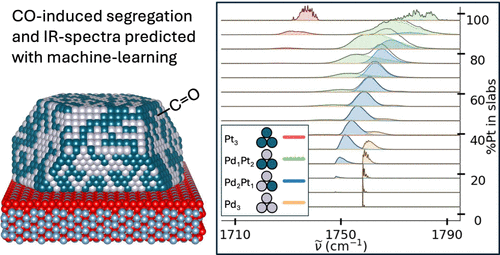
In their study, J. Chen, D. Sharapa and P. Pleßow combine first‑principles DFT with machine‑learning–powered Gaussian Process Regression and Monte Carlo simulations to deliver a predictive, data‑driven picture of surface segregation and CO adsorption on Pd/Pt alloy catalysts. This approach links atomic‑scale structure directly to experimentally observable CO vibrational fingerprints and adsorption energies, unlocking powerful insights into catalytic activity across key CO‑driven reactions. More info here.
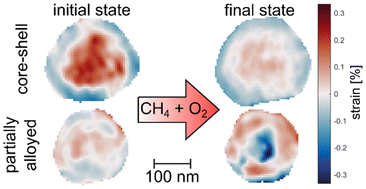
A new study led by Andreas Stierle (DESY, TrackAct project A05) presents an in situ X-ray imaging study of PtPd core–shell nanoparticles during reaction. They show how platinum and palladium redistribute during methane oxidation, including mixing, segregation, and even core–shell inversion at elevated temperatures. These insights help explain how catalyst structure evolves under reaction conditions and provide guidance for designing more active and stable methane oxidation catalysts. Find more here
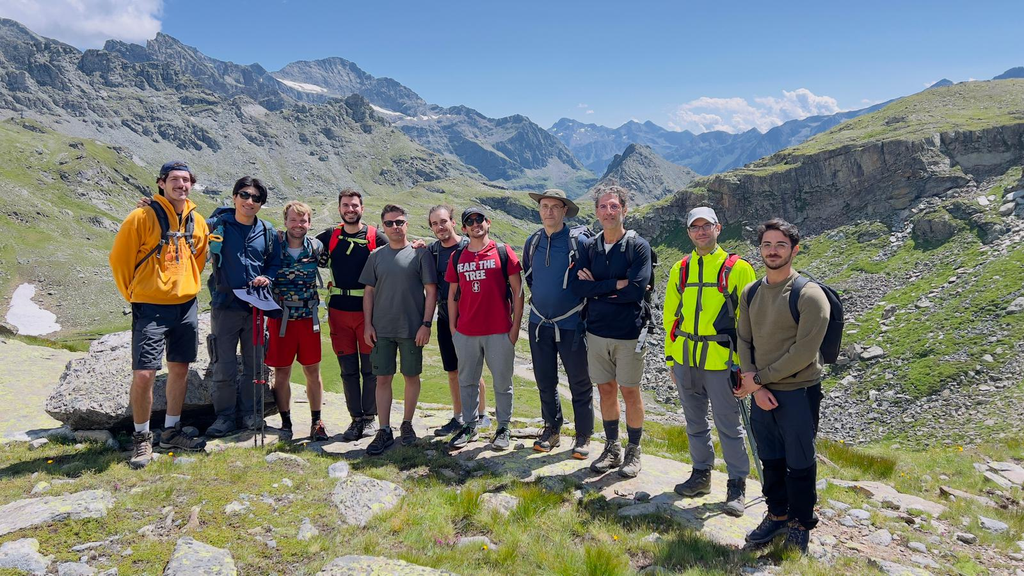
Martin Kutscherauer (Project C07N: Multiscale and Engineering Modeling of Catalytic Reactors) joined the group of Prof. Daniele Marchisio at Politecnico di Torino for four months to develop a model for describing transport and reaction inside mesoporous catalyst by solving the kinetic Boltzmann equation with QBMM. The first results were presented in a keynote lecture at the ECCE 25 in Lisbon in September 2025.
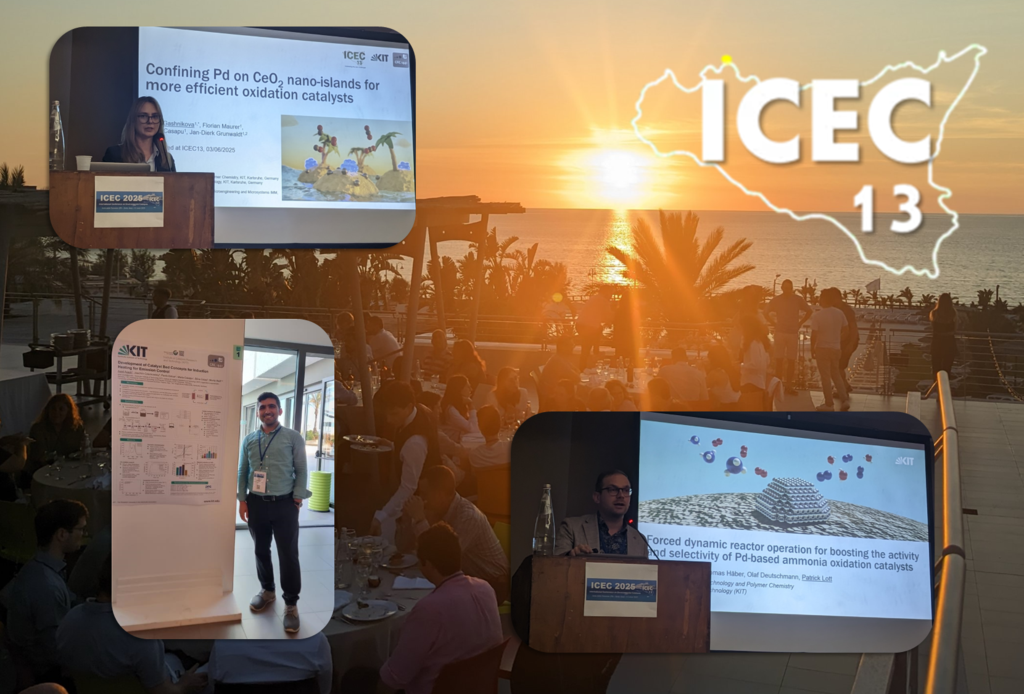
We look back to a fascinating conference fully packed with interesting talks on environmental catalysis. Our 9 TrackAct participants had in total 1 poster (with poster prize!), 2 short oral presentations, 3 oral presentations and 1 plenary lecture in beautiful Sicily! Well done!
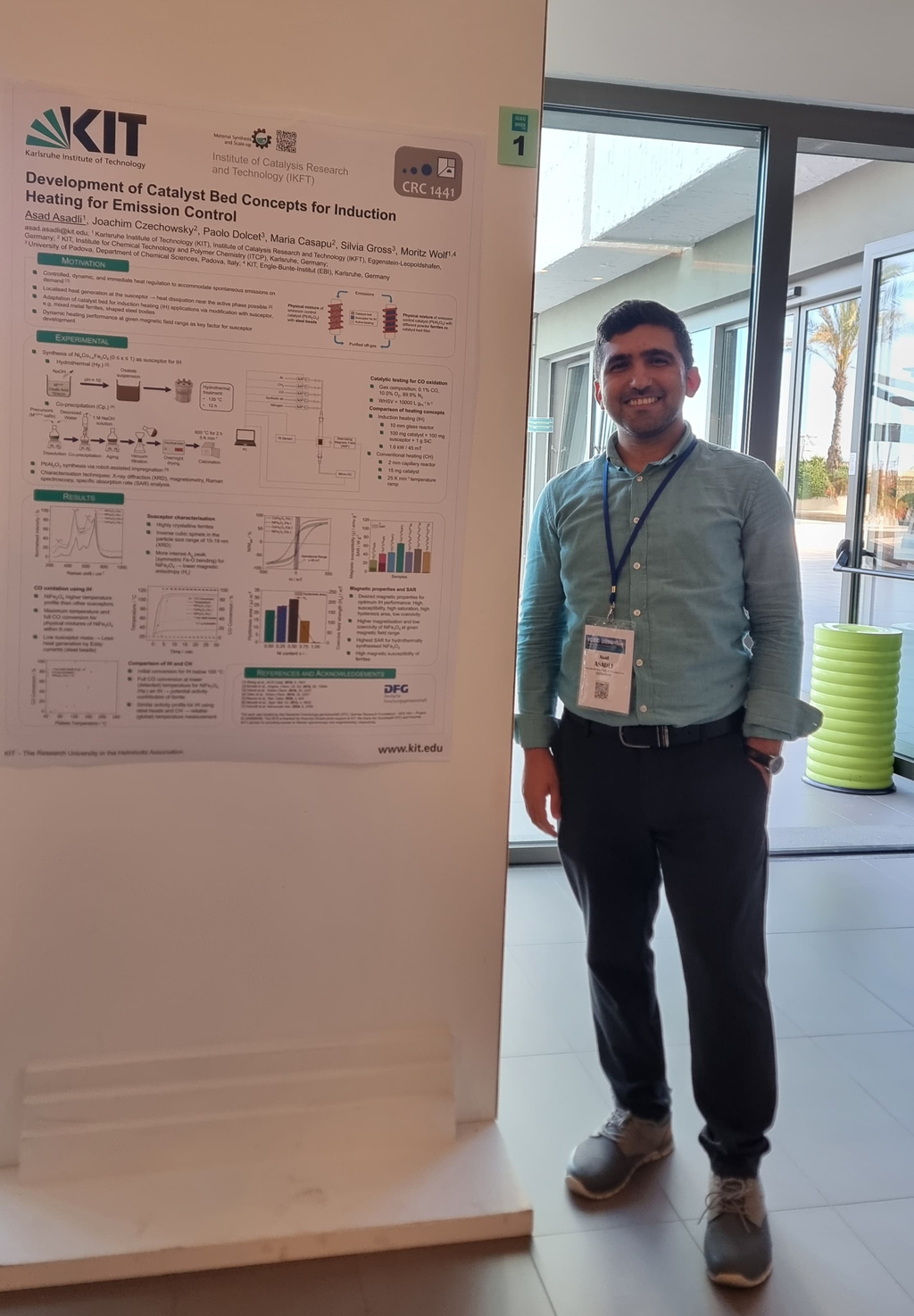
Asad Asadli won a Poster Prize at the International Conference on Environmental Catalysis (ICEC 2025) in Isola delle Femmine/Sicily, Italy. He presented a joint study on induction heating of catalytic reactors from Project C06E, Mercator Fellow Prof. Dr. Silvia Gross and Project B02.